Sunday, 24 January 2010
Halloween Opening Scene
The opening is filmed from the point of view of the killer. A handheld camera is used to film it. This helps to build up tension and suspense for the audience. We are thinking of using this sort of style in our film as we believe it is an effective way of building up tension. However, when we film our opening scene we will try and use more editing techniques than halloween have used. Mise-en-scene has been used very effectively in this opening scene. The use of lighting is crucial in creating a scary atmosphere. This is something we will have to think about when deciding on what lighting to use. The female actor being the victim is very usual for horror films as they appear vulnerable. We will try and get a female actor in to act as the victim to make the scenario more realistic.
We are going to use Halloween as our style model taking ideas from it and incorporating it into our film, as we feel halloween is a successful horror film

Thursday, 21 January 2010
Change in our final decision
We have decided to change the genre of our film from gangster to horror. There are many reasons why we have to decided to change it. First of all after analysing our plot we felt it would be hard to create a realistic gangster films with shootings and loads of special effects. We feel that a horror film would be more easy to emulate. Therefore this will make our film more realistic. Creating an eery and tense atmosphere can be done with just diagetic sounds like leaves rustling. It will be much more easier and effective to create a horror film with this atmosphere to entice the audience. We have analysed various horror films like scream and saw. These films use sound particularly effectively to build up tension. They also use close-up of facial expressions to show the audience that particular person is in danger.
The main reason for this sudden change is we feel the equipment and actors at our disposal is more suited to a horror style movie rather than a gangster style movie.
The two main chaarcters in our film will be a killer and a victim. This is typical of most horror movies. Whereas if we did a gangster movie we would need more actors as there would have been two gangs.
The main reason for this sudden change is we feel the equipment and actors at our disposal is more suited to a horror style movie rather than a gangster style movie.
The two main chaarcters in our film will be a killer and a victim. This is typical of most horror movies. Whereas if we did a gangster movie we would need more actors as there would have been two gangs.
Monday, 18 January 2010
Sound
We will use mostly diagetic sounds in our film as we don't have the resources to create pieces of music to fit in with the action. This will mean we will have to put more emphasis into other areas like the acting and stage set-up in order to create a certain mood and tension without music. However the diagetic sound could help add to the realism of the film. This therefore could entice the audience as it seems more realistic and authentic.
We however will try and create a piece of music to go with our end credits. This is totally dependent on if we can use the appropriate facilities to create a piece of music.
We however will try and create a piece of music to go with our end credits. This is totally dependent on if we can use the appropriate facilities to create a piece of music.
Thursday, 14 January 2010

Wednesday, 6 January 2010
Mise en scene
Costume - we are hopin that we will have suits for the main characters. This is so it will be realistic as we are doing a gangster film.
Lighting - We are planning on filming at night therefore we are going to use very dim lighting if possible to create quite a tense atmosphere.
Props - we plan to use many props including suit case, fake money, car and fake guns. This again is to add to the realism off the film.
Lighting - We are planning on filming at night therefore we are going to use very dim lighting if possible to create quite a tense atmosphere.
Props - we plan to use many props including suit case, fake money, car and fake guns. This again is to add to the realism off the film.
Monday, 4 January 2010
180 degree rule
The 180 degree rule is a crucial filming method used in the film industry. I have included this video as we are going to incorporate this method into our film.
Tuesday, 29 December 2009
Media terms
I feel these techiniques are things we need to try and incorporate into are film clip.
Editing
Shot/reverse shot - is a film technique wherein one character is shown looking at another character (often off-screen), and then the other character is shown looking "back" at the first character. Since the characters are shown facing in opposite directions, the viewer assumes that they are looking at each other.
Eyeline match - is a popular editing technique associated with the continuity editing system. It is based on the premise that the audience will want to see what the character on-screen is seeing. The eyeline match begins with a character looking at something off-screen, there will then be a cut to the object or person at which he is looking. For example, a man is looking off-screen to his left, and then the film cuts to a television that he is watching.
Graphic match - is any cut that emphasizes spatio-temporal continuity and thus, contrasting the conspicuous and abrupt discontinuity of a "jump cut," forms the basis for continuity ('invisible') editing, such as the ubiquitous use of "match on action." In this more general usage, a match cut would thus contrast with jump cuts most immediately and form part of the "reality effect" of continuity editing rather than the visible fractures of spatial, temporal, graphic, and cause-and-effect continuity of jump cuts. Even within continuity editing, though, the match cut is a contrast with cross-cutting between actions in two different locations that are occurring simultaneously or parallel editing, which draws parallels or contrasts between two different time-space locations.
Jump cut - is a cut in film editing in which two sequential shots of the same subject are taken from camera positions that vary only slightly. This type of edit causes the subject of the shots to appear to "jump" position in a discontinuous way. For this reason, jump cuts are considered a violation of classical continuity editing, which aims to give the appearance of continuous time and space in the story-world by de-emphasizing editing. Jump cuts, in contrast, draw attention to the constructed nature of the film.
Crosscutting - is an editing technique most often used in films to establish action occurring at the same time in two different locations. In a cross-cut, the camera will cut away from one action to another action, which can suggest the simultaneity of these two actions but this is not always the case.
Cutaway/insert - is the interruption of a continuously filmed action by inserting a view of something else. It is usually, although not always, followed by a cutback to the first shot.
Dissolve - is a gradual transition from one image to another. In film, this effect is created by controlled double exposure from frame to frame; transiting from the end of one clip to the beginning of another.
Fade-in/Fade out - A fade-out is a gradual transformation of an image to black; whereas a fade-in is the opposite. A dissolve is a simultaneous fade-out of the shot being cut from, and fade-in of the shot being cut to. The dissolve can be said to show a short ellipsis; whereas a fade-out means a long one.
Wipe - is a gradual spatial transition from one image to another. One image is replaced by another with a distinct edge that forms a shape. A simple edge, an expanding circle, or the turning of a page are all examples.
Long take - is an uninterrupted shot in a film which lasts much longer than the conventional editing pace either of the film itself or of films in general, usually lasting several minutes. It can be used for dramatic and narrative effect if done properly, and in moving shots is often accomplished through the use of a dolly or Steadicam.
Camera shots/movemtents
Long shot - A long shot typically shows the entire object or human figure and is usually intended to place it in some relation to its surroundings. It has been suggested that long-shot ranges usually correspond to approximately what would be the distance between the front row of the audience and the stage in live theatre. It is now common to refer to a long shot as a "wide shot" because it often requires the use of a wide-angle lens. When a long shot is used to set up a location and its participants in film and video, it is called an establishing shot.
Close-up - a shot taken from a close distance in which the scale of
the object is magnified, appears relatively large and fills
the entire frame to focus attention and emphasize its
importance
Medium shot - refers to a conventional camera shot filmed from a
medium distance; although it is difficult to precisely
define, it usually refers to a human figure from the waist.
Two shot - a medium or close-up camera shot of two people (often
in dialogue with each other), framed from the chest up.
High angle - a shot in which the subject is filmed from above and the
camera points down on the action, often to make the
subject small, weak and vulnerable.
Low angle - a shot in which the subject is filmed directly from below
and the camera points up at the action, to make the
subject appear larger, more formidable and menacing, or
perhaps tall and regal.
Editing
Shot/reverse shot - is a film technique wherein one character is shown looking at another character (often off-screen), and then the other character is shown looking "back" at the first character. Since the characters are shown facing in opposite directions, the viewer assumes that they are looking at each other.
Eyeline match - is a popular editing technique associated with the continuity editing system. It is based on the premise that the audience will want to see what the character on-screen is seeing. The eyeline match begins with a character looking at something off-screen, there will then be a cut to the object or person at which he is looking. For example, a man is looking off-screen to his left, and then the film cuts to a television that he is watching.
Graphic match - is any cut that emphasizes spatio-temporal continuity and thus, contrasting the conspicuous and abrupt discontinuity of a "jump cut," forms the basis for continuity ('invisible') editing, such as the ubiquitous use of "match on action." In this more general usage, a match cut would thus contrast with jump cuts most immediately and form part of the "reality effect" of continuity editing rather than the visible fractures of spatial, temporal, graphic, and cause-and-effect continuity of jump cuts. Even within continuity editing, though, the match cut is a contrast with cross-cutting between actions in two different locations that are occurring simultaneously or parallel editing, which draws parallels or contrasts between two different time-space locations.
Jump cut - is a cut in film editing in which two sequential shots of the same subject are taken from camera positions that vary only slightly. This type of edit causes the subject of the shots to appear to "jump" position in a discontinuous way. For this reason, jump cuts are considered a violation of classical continuity editing, which aims to give the appearance of continuous time and space in the story-world by de-emphasizing editing. Jump cuts, in contrast, draw attention to the constructed nature of the film.
Crosscutting - is an editing technique most often used in films to establish action occurring at the same time in two different locations. In a cross-cut, the camera will cut away from one action to another action, which can suggest the simultaneity of these two actions but this is not always the case.
Cutaway/insert - is the interruption of a continuously filmed action by inserting a view of something else. It is usually, although not always, followed by a cutback to the first shot.
Dissolve - is a gradual transition from one image to another. In film, this effect is created by controlled double exposure from frame to frame; transiting from the end of one clip to the beginning of another.
Fade-in/Fade out - A fade-out is a gradual transformation of an image to black; whereas a fade-in is the opposite. A dissolve is a simultaneous fade-out of the shot being cut from, and fade-in of the shot being cut to. The dissolve can be said to show a short ellipsis; whereas a fade-out means a long one.
Wipe - is a gradual spatial transition from one image to another. One image is replaced by another with a distinct edge that forms a shape. A simple edge, an expanding circle, or the turning of a page are all examples.
Long take - is an uninterrupted shot in a film which lasts much longer than the conventional editing pace either of the film itself or of films in general, usually lasting several minutes. It can be used for dramatic and narrative effect if done properly, and in moving shots is often accomplished through the use of a dolly or Steadicam.
Camera shots/movemtents
Long shot - A long shot typically shows the entire object or human figure and is usually intended to place it in some relation to its surroundings. It has been suggested that long-shot ranges usually correspond to approximately what would be the distance between the front row of the audience and the stage in live theatre. It is now common to refer to a long shot as a "wide shot" because it often requires the use of a wide-angle lens. When a long shot is used to set up a location and its participants in film and video, it is called an establishing shot.
Close-up - a shot taken from a close distance in which the scale of
the object is magnified, appears relatively large and fills
the entire frame to focus attention and emphasize its
importance
Medium shot - refers to a conventional camera shot filmed from a
medium distance; although it is difficult to precisely
define, it usually refers to a human figure from the waist.
Two shot - a medium or close-up camera shot of two people (often
in dialogue with each other), framed from the chest up.
High angle - a shot in which the subject is filmed from above and the
camera points down on the action, often to make the
subject small, weak and vulnerable.
Low angle - a shot in which the subject is filmed directly from below
and the camera points up at the action, to make the
subject appear larger, more formidable and menacing, or
perhaps tall and regal.
Monday, 30 November 2009

Friday, 20 November 2009
Time management
We practiced filimg in our preliminary task, however came across many problems. Therefore we decided to spend time practicing how to use the editing software so when we need to edit our actuall film we will be prepared.
Tuesday, 17 November 2009
Preliminary Filming Task
We created this short film to practice various techniques including camera movement, editing, mise-en-scene and sound. We tried to incorporate these techniques as best as we could. However as this was are first time doing a film clip like this we did encounter many problems.
We managed to film it with a video recorder with relative ease. We included close-up shots, over the shoulder shots, and long shots. Are camera man also tried to incorporate the usage of the 180 degree rule. I feel he did this fairly sucessfully. I feel we managed to capture emotion through the usage of camera shots and movement. However due to the actors at are disposole it could of been improved dramatically.
Due to the lack of props and costume we could not use mise-en-scene as a major technique. This is a factor we will need to improve on when making are proper film clip. We will need to think about costume, lighting, props and location to add to the realism and to add tension or dispear.
We had extreme difficulties with the editing. It was our first time using the editing software and we struggled to come to grips with it. We have learnt from our mistakes and I think our actual film clip will benefit from this. We also had problems with the sound as are camera man did not think there was a mic on the video camera.
Overall I am fairly disapointed with are preliminary task. We encountered many difficulties and problems. We will have to make improvements in our real task and I feel we can improve dramatically.
Thursday, 12 November 2009
Scream
Scream uses intersting techniques to build up tension and suspense. It combines camera movement, mise en scene, editing and sound to create representation and makes it exciting for the audience. It has given me ideas for my film by how it build up tension and suspense as horror is a genre ime thinkin of doing.
When we meet the girl in the opening scene we immidatlet now she is the main character and is the one in danger due to her appearence. She has blonde hair and looks small and fragile. This straight away suggests to the audience that she is going to be the victim as she is represented as vulnerable through the use of mise en scene.
The producer use diagetic sound to create a scary tense atmosphere. The sounds of crickets in the garden and the amplified sound of the swing creeking adds huge effect to the scene. It suggests to the audience that she is alone in the middle of nowhere. This then adds a tense atmosphere as the audience is being built up to something bad happening. There is fairly tense scary music played as well in various parts of the scene again to build up tension and anxiety.
Various close ups of the girls face are used. This is to show the fear and fright in her face. It suggests to the audience that she is in extreme danger. The producer has also used camera movement to create tension and anxiety. He has used a lot of slow takes to keep the audience on the edge of their seats.
The editing throughout this scene is at a fairly fast pace. This is to keep the audience on edge and it wants you to realise the girls life is quickly passing by and in extreme danger.
I feel some of these techniques used will assist me when makeing my film as I could try and implicate some of then if I choose to do a horror movie.
Tuesday, 10 November 2009
Goodfellas
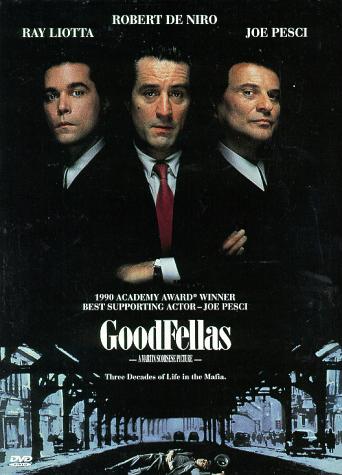
Possible genre for for our film as gangster movies are more interesting and exciting to make.
Saturday, 24 October 2009
Time managment
We have been analysing films and trailers in order to help us decide what sort of film we want to create. We have carried out research in order to help us make our final decision. We have spent 4-5 hours in total in the planning process.
Thursday, 10 September 2009
The Godfather
google
The Godfather is a classic gangster film. It is emotional yet extremley violent. I feel the aim of the film is to put the point accross of family values and power. It makes the audience realise how important family, power and most importantly respect is to a traditional mobster family
Brief outline of story - The story starts as Vito Corleone, the head of a New York Mafia, oversees his daughter's wedding. His son Michael has just come home from the war, but does not intend to become part of his father's business. Through Michael's life the nature of the family business becomes clear. The business of the family is just like the head of the family, kind and benevolent to those who give respect, but given to ruthless violence whenever anything stands against the good of the family. Don Vito lives his life in the way of the old country, but times are changing and some don't want to follow the old ways and look out for community and "family". An up and coming rival of the Corleone family wants to start selling drugs in New York, and needs the Don's influence to further his plan. Vito Corleone ends up diening and his son Michael takes the helm of the Don.
The Godfather is a classic gangster film. It is emotional yet extremley violent. I feel the aim of the film is to put the point accross of family values and power. It makes the audience realise how important family, power and most importantly respect is to a traditional mobster family
Brief outline of story - The story starts as Vito Corleone, the head of a New York Mafia, oversees his daughter's wedding. His son Michael has just come home from the war, but does not intend to become part of his father's business. Through Michael's life the nature of the family business becomes clear. The business of the family is just like the head of the family, kind and benevolent to those who give respect, but given to ruthless violence whenever anything stands against the good of the family. Don Vito lives his life in the way of the old country, but times are changing and some don't want to follow the old ways and look out for community and "family". An up and coming rival of the Corleone family wants to start selling drugs in New York, and needs the Don's influence to further his plan. Vito Corleone ends up diening and his son Michael takes the helm of the Don.
Subscribe to:
Posts (Atom)